

From Flintstones to Gummies: Same Story, New Packaging
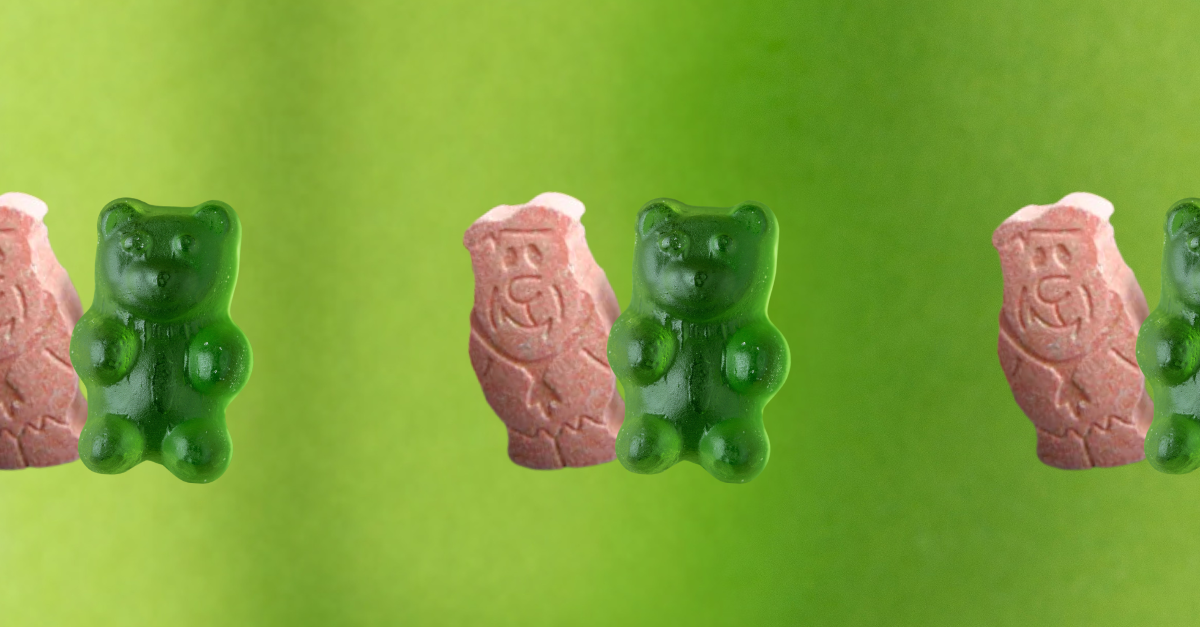
Many of us grew up with a very specific kind of wellness ritual: twist the orange cap, shake out a chalky little cartoon character, chew it like candy, and feel like the day’s nutrition problem was solved. It was fun. It was also marketing genius.
The real product wasn’t just the vitamins; it was the belief that something sweet, colorful, and kid‑friendly could stand in for nourishment. Once you learn that story early, the modern supplement aisle makes perfect sense. Flintstones chewables were the training wheels. Gummies are the adult version.
🎧 Prefer to Listen?
Reading’s great, but sometimes it’s nice to just listen in. So we turned today’s blog into a conversation. Our two AI sidekicks, Max and Chloe, break down today’s blog so you can listen on the go!
How We Got Hooked on Candy Vitamins
Flintstones chewables didn’t appear by accident; they were designed to get kids (and parents) comfortable with a daily pill ritual by making it feel like a treat. The shapes, colors, and cartoon tie‑in all said, “This is safe, fun, and responsible,” even though most of the formula was sugar, artificial flavors, and synthetic vitamins.
That model worked so well it quietly reshaped what “wellness” looks like: something you chew like candy to check a box, instead of real food that actually nourishes you. Fast‑forward a few decades, and now the same woman who once chewed Dino before school is standing in Target comparing adult gummy multis that look, taste, and feel exactly like the childhood ritual—just with “women’s health” printed on the label.
Gummies Look Healthier Than They Are
To be clear, gummies aren’t “evil.” They’re just built for compliance and palatability, not necessarily for nutrient density. Most gummy vitamins:
Need sugar, syrup, or sugar alcohols to hold their shape and taste good.
Often have lower doses of certain vitamins and minerals than tablets or capsules, because there’s only so much you can pack into that gel base.
Can lose potency faster over time, especially for more fragile nutrients, if they’re not carefully formulated and stored.
Some research has shown that a well‑designed gummy can deliver similar blood levels of certain nutrients (like vitamin D) as a tablet, but that’s under controlled conditions with specialized manufacturing. In the real world, what most of us actually buy is driven more by taste, texture, and “cute factor” than rigorous nutrient design.
And that’s the point: gummies keep us rooted in the same story Flintstones sold us—if it tastes like candy and says “vitamin,” it must be covering my bases. Articles asking whether echo the same concern.
The Problem: Candy Vitamins Don’t Fix Real Nutrient Gaps
Here’s the disconnect: the symptoms many women are dealing with—low energy, heavy periods, brain fog, mood swings—usually aren’t coming from a lack of a rainbow gummy. They’re often tied to deeper nutrient gaps (iron, B12, folate, fat‑soluble vitamins, minerals) and a stressed gut‑hormone axis that a sugary chewable was never designed to repair.
You can hit “100% Daily Value” of a few synthetic vitamins and still feel exhausted if:
Your iron intake (especially heme iron) is low.
Your B12 and folate status is marginal.
Your gut is irritated, inflamed, or not absorbing well.
No amount of berry‑flavored candy vitamins is going to replace a truly nutrient‑dense meal or rebuild a calm, resilient gut lining.
What Sarenova Does Differently
At Sarenova, we’re not trying to make a “more grown‑up Flintstones.” We’re trying to change the story. Instead of candy‑adjacent supplements, we focus on:
Bioavailable, food‑based nutrients from grass‑fed beef organs that already contain heme iron, B12, folate, vitamin A, copper, zinc, and other cofactors in the forms your body recognizes.
Slippery elm and yarrow to help calm the very tissues that have to absorb whatever you take.
Minimal, clean excipients and capsule delivery, so we’re not asking your body to process extra sugar and dyes under the label of “self‑care.”
We also care deeply about the experience. That’s why we use a gentle, scented insert in the package… just enough to give a hint of flavor when you open it, without adding sugar, sweeteners, or anything your body doesn’t need.
We understand that an invigorating moment you actually look forward to each day matters just as much as what’s on the label.
It’s a very different philosophy from: “How do we make this taste like candy so you won’t forget it?”
Our question is: “How do we give your body the raw materials it’s been missing, in a way your gut and hormones can actually use?”
Growing Out of the Candy Ritual
If Flintstones were the training wheels and gummies are the adult costume version, Sarenova is about learning to ride the real bike.
It’s about moving from pretend nourishment to actual nourishment—nutrients that change lab work, cycles, and how you feel at 3 p.m., not just how your supplement drawer looks on Instagram.
You don’t have to throw away every gummy in your pantry tomorrow. But if you’ve been living the “I take my vitamins, so why do I still feel wrecked?” story, it might be time to ask a different question.
Not “Which gummy has the cutest label?” but “What would it look like to actually replenish what my body’s been missing?”
That’s the lane we stay in at Sarenova: not more candy disguised as wellness, but real nourishment for women who are done running on empty.
💡 Key Takeaways
Candy vitamins conditioned us to equate sweet, colorful chewables with “being healthy,” even when they’re mostly sugar and synthetic additives.
Gummy vitamins are built for taste and compliance, which often means more sugar and less room for meaningful nutrient doses.
Nutrient gaps like low iron, B12, and folate are a major driver of fatigue, heavy periods, and brain fog—issues gummies alone rarely fix.
The form of nutrients matters, with heme iron and food‑based micronutrients generally being better absorbed than many synthetic versions.
A supplement ritual should support true nourishment, not just recreate a candy experience with a health halo.
-
(AI-generated conversation and transcript)
Why_your_gummy_vitamins_are_failing_you
[00:00:00] Max: I want you to take a quick trip back in time with me for a second. Picture yourself in your childhood kitchen. You reach into the cabinet for a very specific, um. Slightly clunky plastic bottle.
[00:00:12] Chloe: Oh, with the big orange cap?
[00:00:13] Max: Yes, exactly. The orange cap. You twist that off, give it a shake, and out pops this chalky little character.
[00:00:20] Chloe: And you're definitely digging around for the dino.
[00:00:22] Max: Always the dino. Mm-hmm. Or you know, maybe you went right for Fred, but you pop it in your mouth, you chewed up like a piece of candy and boom, your
[00:00:30] Chloe: health is sorted for the day.
[00:00:31] Max: Right. You felt like your entire daily nutrition problem was completely solved before you even put your backpack on.
[00:00:38] We all grew up with this exact wellness ritual.
[00:00:40] Chloe: It was fast, it was sweet, and honestly it just felt like a treat.
[00:00:44] Max: It did. But while that innocent little memory holds a ton of nostalgia for us, yeah, the source of material we are looking at today suggests it actually laid the groundwork for a pretty massive structural misunderstanding about our health.
[00:00:58] Chloe: Yeah, it's a shared [00:01:00] generational memory, but more importantly, it was a behavioral training ground. That daily ritual completely shaped our baseline expectations for how we view taking care of ourselves today,
[00:01:10] Max: which is the core focus of today's discussion. For this deep dive, we are examining a fascinating document titled From Flintstones to Gummies.
[00:01:19] Same story, new packaging.
[00:01:21] Chloe: Mm. It's a great read.
[00:01:22] Max: It really is. And our mission today is to explore how this highly specific childhood ritual completely reshaped our modern concept of what wellness is actually supposed to look like. Both physically and chemically,
[00:01:34] Chloe: right. Bypassing all the clever marketing.
[00:01:36] Max: Exactly. We wanna uncover the actual biochemical truth about what is inside those incredibly popular adult gummy vitamins that are probably currently sitting in your pantry.
[00:01:45] Chloe: We're sitting on your desk at work.
[00:01:46] Max: Yeah. Okay. Let's unpack this. I want you to mentally picture the modern supplement aisle at a store like Target,
[00:01:53] Chloe: just endless rows of clear aesthetic jars.
[00:01:56] Max: Right. If you scan the shelves of adult women's health or [00:02:00] you know, daily wellness gummies, you start to realize that they look, taste and function almost identically to that childhood ritual.
[00:02:07] Chloe: Uh, to understand why that modern aisle looks the way it does, we have to look at the psychology and the industrial history behind those original chewables.
[00:02:15] Max: Because they didn't just appear outta nowhere.
[00:02:17] Chloe: No, not at all. It wasn't because a pharmaceutical company just desperately wanted to make kids happy. They were intentionally designed to solve a very specific friction point for the supplement industry,
[00:02:28] Max: which is compliance. Right,
[00:02:29] Chloe: exactly. Compliance. They needed to get kids and the parents purchasing the products comfortable with the daily pill ritual.
[00:02:36] Max: Yeah.
[00:02:37] Chloe: And the most efficient way to bypass a child's natural rejection of a bitter pill.
[00:02:42] Max: Is to camouflage it as candy,
[00:02:43] Chloe: right? What's fascinating here is the sheer brilliance of that marketing pivot.
[00:02:48] Max: It really worked.
[00:02:49] Chloe: It worked flawlessly. The shapes, the bright colors, the cartoon tie-ins, they totally bypassed our critical thinking.
[00:02:57] They signal to the consumer, this is safe. [00:03:00] This is a fun reward, and buying this makes you a responsible health conscious person.
[00:03:04] Max: And they achieved all of this despite the fact that the formula inside those little characters was fundamentally just. Sugar, artificial flavors and highly processed synthetic vitamin isis.
[00:03:16] Chloe: It was basically candy with a dusting of chemistry.
[00:03:18] Max: A dusting of chemistry. I like that. And the long-term impact of that marketing pivot is actually staggering when you really look at the data in the source.
[00:03:26] Chloe: Oh, it completely shifted consumer behavior.
[00:03:29] Max: It was so effective that it quietly redefined the entire concept of wellness for a whole generation.
[00:03:35] Wellness stopped being about the complex biological process of consuming real food.
[00:03:40] Chloe: Food that actively nourishes your cellular pathways
[00:03:42] Max: exactly. Instead, it was reduced to a transactional habit, just checking a box, a piece of candy.
[00:03:47] Chloe: The source material frames this perfectly. Those chewable cartoon characters were the training wheels,
[00:03:52] Max: the training wheels, and those chic minimalist jars of adult gummies that cost $40.
[00:03:59] Chloe: They're just the [00:04:00] grownup costume version of the exact same behavioral loop.
[00:04:03] Max: We literally just swapped out the dyno shape. For a sleek, adaptogen infused berry flavored square,
[00:04:09] Chloe: the one that says self-care and a really nice font on the side,
[00:04:12] Max: right? We internalized the story early on that something sweet and colorful could legitimately stand in for deep nourishment.
[00:04:19] Chloe: And once that neurological association is hardwired into your brain, that health equals a sweet reward. The modern supplement aisle makes perfect sense.
[00:04:29] Max: The industry didn't need to invent a new behavior for adults.
[00:04:32] Chloe: No, they just needed to update the aesthetics of the packaging.
[00:04:36] Max: Now, to be fair to the manufacturers, we do need to transition to the physical reality of what an adult gummy vitamin actually is,
[00:04:43] Chloe: right?
[00:04:43] Because gummies aren't inherently malicious.
[00:04:45] Max: No, there's no grand conspiracy behind a gummy bear. The source is very clear that they're simply built for compliance. They're designed so that you actually wanna take them every day.
[00:04:54] Chloe: But when you prioritize palatability, you fundamentally sacrifice nutrient [00:05:00] density
[00:05:00] Max: because the physical form of the gummy itself.
[00:05:03] Forces some major biochemical compromises.
[00:05:05] Chloe: Yeah. When we break down the actual mechanics and chemistry of a gummy vitamin, the text highlights two major drawbacks. The first is what we can call the space issue,
[00:05:15] Max: which is really just a matter of simple physics.
[00:05:17] Chloe: Exactly. To make a gummy hold its shape, give it that.
[00:05:20] Bouncy texture and actually taste good enough to chew. You need a structural base,
[00:05:26] Max: and that base is typically made of gelatin or pectin,
[00:05:29] Chloe: right? Gelatin or pectin combined with sugar syrups or sugar alcohols.
[00:05:33] Max: Mm-hmm.
[00:05:34] Chloe: And because this gel base takes up a massive percentage of the physical volume in the gummy,
[00:05:39] Max: sometimes up to 80%,
[00:05:41] Chloe: right.
[00:05:41] Up to 80%. So there is simply a limit to how much actual active nutrition you can pack into the remaining space.
[00:05:49] Max: You literally just run outta physical room.
[00:05:50] Chloe: Yes, as a result, gummies often contain significantly lower doses of certain bulky vitamins and minerals compared to what you could easily fit into a standard [00:06:00] dry capsule.
[00:06:01] Max: The candy matrix just takes up the space where the actual micronutrients are supposed to go. Hmm. Which reminds me of the second major drawback mentioned in the source,
[00:06:09] the
[00:06:09] Chloe: potency issue.
[00:06:10] Max: Yes.
[00:06:11] Chloe: Yeah.
[00:06:11] Max: I think we have all had that experience of reaching into the back of a cabinet and finding a forgotten fossilized rock hard gummy bear.
[00:06:20] Chloe: Oh, yeah. Totally inedible
[00:06:21] Max: beyond just getting stale though. The environment inside a gummy is fundamentally different from a dry capsule.
[00:06:27] Chloe: Because of the moisture content,
[00:06:29] Max: right? The moisture and the heat required during manufacturing gummies can lose their chemical potency much faster over time.
[00:06:37] Chloe: That moisture is the absolute enemy of stability for a lot of fragile nutrients.
[00:06:42] Water soluble vitamins like vitamin C or the B complex family are notoriously unstable in gummy maes
[00:06:49] Max: does. They degrade.
[00:06:50] Chloe: They degrade fast. If the gummy isn't perfectly formulated, coated and stored at optimal temperatures, the amount of the active vitamin you are actually digesting months down the line [00:07:00] might be significantly less than the dosage printed on the label.
[00:07:03] Max: The degradation rate is just a massive hurdle for formulators.
[00:07:06] Chloe: There's a huge problem.
[00:07:07] Max: Now as a strict science caveat, the text does note that it's not entirely impossible to get nutrition from this format.
[00:07:14] Chloe: No, it's not impossible.
[00:07:16] Max: There is some clinical research showing that a really well-designed gummy can deliver similar blood serum levels of certain nutrients like vitamin D, for example, as a traditional tablet.
[00:07:26] Chloe: So it is physically possible to formulate a gummy that works.
[00:07:30] Max: Yes. But the text emphasizes that these successful trials usually happen under highly controlled conditions. They use very specialized manufacturing processes that the average drugstore brand simply isn't using.
[00:07:43] Chloe: If we connect this to the bigger picture, we have to look at how these chemical limitations play out in the real world inside the consumer's body,
[00:07:51] Max: in the reality of everyday life,
[00:07:52] Chloe: right?
[00:07:53] In reality, what consumers are buying in that target aisle isn't driven by peer-reviewed absorption rates or rigorous [00:08:00] nutrient design.
[00:08:00] Max: It's driven almost entirely by taste, texture, and the visual aesthetic.
[00:08:04] Chloe: Because the supplement industry knows that we are still operating on that false childhood belief.
[00:08:10] If it tastes like candy and has the word vitamin legally printed on the label, it must be covering my biological bases.
[00:08:16] Max: We assume the acute jar is doing the heavy lifting for our cellular health.
[00:08:21] Chloe: Well, totally ignoring the limitations of the delivery system.
[00:08:25] Max: That assumption brings us to the daily physical reality that so many of you listening are likely dealing with right now.
[00:08:32] You are highly educated on health.
[00:08:35] Chloe: You're doing everything right,
[00:08:36] Max: you are doing everything right, and you are taking the trendy rainbow gummies. Every morning.
[00:08:41] Chloe: Yeah,
[00:08:41] Max: but you are still struggling.
[00:08:43] Chloe: You're dealing with chronic low energy,
[00:08:45] Max: heavy and painful periods. Persistent brain fog, unexplained mood swings.
[00:08:50] Here's where it gets really interesting. The text points out that these symptoms usually aren't being caused by a lack of the synthetic vitamins found in a berry flavored gummy.
[00:08:58] Chloe: No. They're tied to something much [00:09:00] deeper,
[00:09:00] Max: deep, complex nutrient gaps and a stressed gut hormone axis.
[00:09:04] Chloe: Let's actually define that term because stressed gut hormone axis gets thrown around a lot in wellness circles without much biological context.
[00:09:12] Max: It's become a bit of a buzzword.
[00:09:13] Chloe: It really has. The gut hormone axis is essentially the communication highway between your digestive system and your endocrine system.
[00:09:21] Max: Okay, so how does that break down?
[00:09:22] Chloe: Well, when your gut lining is inflamed, maybe from stress, poor diet or environmental toxins, the structural integrity of your intestines is compromised.
[00:09:32] This inflammation triggers a stress response, which spikes your cortisol
[00:09:36] Max: and elevated cortisol throws everything else off
[00:09:38] Chloe: exactly. When cortisol is chronically elevated, it cascades down and disrupts the production imbalance of other hormones like estrogen, progesterone, and thyroid hormones.
[00:09:49] Max: So a problem that starts with.
[00:09:50] Poor absorption in the gut ultimately manifests as brain fog, heavy periods, or profound fatigue.
[00:09:57] Chloe: Yes.
[00:09:58] Max: And those are complex [00:10:00] systemic issues that a sugary chewable was simply never designed to repair. Uh, this is the crux of the nutrient disconnect the source talks about. Mm-hmm. You can look at the back of a gummy bottle, see that it legally claims.
[00:10:12] You are getting 100% of your daily value of various synthetic vitamins
[00:10:17] Chloe: and still feel completely wrecked
[00:10:19] Max: exactly. The source details exactly why this chemical disconnect happens.
[00:10:24] Chloe: It highlights three critical factors where synthetics fail at the cellular level first. Your iron intake might be low.
[00:10:31] Specifically your intake of he iron Hemi? Yes, he, Myron is the highly bioavailable form of iron found exclusively in animal products. Its molecular structure includes a porphyrin ring that allows it to be absorbed intact by the human intestine.
[00:10:46] Max: But standard gummies don't use that
[00:10:48] Chloe: many. Standard gummies don't even include iron at all because it tastes highly metallic and it ruins the candy experience.
[00:10:54] Max: And if they do include it,
[00:10:55] Chloe: if they do include it, they use non-heme synthetic iron salts, which have a [00:11:00] very low absorption rate and often cause massive gastrointestinal upset,
[00:11:04] Max: which is incredibly frustrating. If you are a. Woman dealing with heavy cycles trying to replenish your iron stores.
[00:11:10] Chloe: Yeah. And the very supplement you're taking is either missing the iron entirely or just giving you stomach cramps.
[00:11:16] Max: It's a losing battle.
[00:11:17] Chloe: It is. The second factor is the marginal status of B12 and folate. The forms of these vitamins used in mass market gummies are almost always synthetic isolates like cyanocobalamin for B12 or folic acid for folate,
[00:11:33] Max: and the body has to convert those,
[00:11:34] Chloe: right?
[00:11:34] Max: Right.
[00:11:35] Chloe: To use these synthetic forms, your body has to undergo a complex enzymatic process called methylation to convert them into active forms.
[00:11:43] The cells can actually use,
[00:11:45] Max: but not everyone can do that efficiently.
[00:11:47] Chloe: Exactly. Many people have genetic variations that make this conversion process highly inefficient. So you swallow the vitamin, but it floats around your bloodstream unable to actually enter the cell and generate energy.
[00:11:59] Max: It's [00:12:00] like having the blueprint for a house, but none of the actual building materials.
[00:12:03] Chloe: That's a great way to put it. And that leads to the third and perhaps most foundational factor, the state of your gut itself,
[00:12:10] Max: the environment where the absorption is supposed to happen.
[00:12:13] Chloe: Right. If your gut is irritated, inflamed, or the tiny little finger like projections called VII that absorb nutrients are blunted, it literally does not matter how many synthetic vitamins you swallow,
[00:12:24] Max: you are physically incapable of assimilating them into your bloodstream.
[00:12:28] Chloe: The bottom line here, and the source is wonderfully blunt about this, is that no amount of candy coated vitamins is going to replace the complex biological matrix of a truly nutrient dense whole food,
[00:12:39] Max: and it certainly isn't gonna rebuild a. Calm, resilient gut lining.
[00:12:44] Chloe: You cannot out supplement chronic gut inflammation with an isolated synthetic chemical wrapped in pectin and sugar.
[00:12:51] Max: Which brings us to a really fascinating part of our deep dive today. The document highlights a specific company called ANOVA that is [00:13:00] actively trying to rewrite this entire narrative.
[00:13:02] Chloe: They're taking a very different approach.
[00:13:04] Max: They really are. They are looking at this massive multi-billion dollar gummy landscape and saying.
[00:13:10] We aren't gonna make a slightly better, more grownup flintstone.
[00:13:13] Chloe: They are taking a completely different, much more biologically grounded path.
[00:13:16] Max: So what does this all mean? Grass fed beef organs, that is a massive leap from a berry flavored gummy. How does the source justify making such an intense switch?
[00:13:28] Chloe: Well, it is a massive leap aesthetically, but biologically it is actually a return to form. Sonova's approach is a fundamental shift in formulation strategy.
[00:13:37] Max: According to the text, their philosophy is rooted entirely in bioavailable whole food matrices,
[00:13:43] Chloe: right. Instead of synthesizing an isolated vitamin in a lab to hit an arbitrary 100% daily value metric, they are sourcing their nutrients directly from grass fed beef organs,
[00:13:54] Max: which makes sense evolutionarily,
[00:13:55] Chloe: exactly.
[00:13:55] The evolutionary biology rationale here is that the human digestive tract [00:14:00] evolved over millions of years. To recognize, break down and extract nutrients from whole foods, not isolated chemicals,
[00:14:07] Max: because when you eat a whole food, you aren't just getting one isolated vitamin. You're getting the entire package that helps your body process it.
[00:14:13] Chloe: Exactly the point. Beef organs naturally contain those critical nutrients we just talked about. Highly absorbable. He iron. Methylated B12, active folate, vitamin A, copper and zinc,
[00:14:24] Max: all the aviators,
[00:14:25] Chloe: all of them. But more importantly, they contain them alongside naturally occurring co-factors.
[00:14:31] Max: Let's explain co-factors for a second.
[00:14:33] Chloe: Sure. For those unfamiliar with the term co-factors are essentially the biological keys or helper molecules that unlock the cell doors.
[00:14:41] Max: So without the key, the nutrient is longed out.
[00:14:43] Chloe: Right. If you take a massive dose of synthetic vitamin A. Without the corresponding co-factors like fat and specific enzymes, your body struggles to use it,
[00:14:54] Max: but Whole Foods already have the keys.
[00:14:56] Chloe: Whole foods provide the vitamin and the required co-factors in the [00:15:00] exact ratios. The human body already recognizes. It entirely bypasses the absorption bottlenecks common with synthetic ice litters
[00:15:08] Max: beyond the beef organs. The text notes that sonova includes specific herbs in their formulation, namely slippery el Minero.
[00:15:16] Chloe: Yes,
[00:15:16] Max: I noticed that when reading through the source. That ties directly back into the whole concept of the stressed gut hormone axis, doesn't it?
[00:15:23] Chloe: It addresses the root cause directly. They recognize that throwing highly bioavailable nutrients at a highly inflamed digestive system is still a losing battle.
[00:15:31] Max: So what do the herbs do?
[00:15:33] Chloe: Slippery Elm contains mucilage, a substance that becomes a slick gel when mixed with water. It literally coats and soothes the irritated lining of the stomach and intestines.
[00:15:43] Max: Like a protective layer.
[00:15:45] Chloe: Exactly. And Yarro has long been studied for its anti-inflammatory and astringent properties helping to tighten those cellular junctions in the gut.
[00:15:54] Max: So it's a dual action strategy.
[00:15:56] Chloe: Provide the raw nutritional materials in a bioavailable [00:16:00] form and simultaneously calm the gut tissue so they're primed to actually receive and transport those nutrients.
[00:16:06] Max: It's treating the environment and delivering the supplies at the same time.
[00:16:10] Chloe: Exactly.
[00:16:11] Max: Furthermore, the texts specifically points out that they do all of this using minimal clean excipients inside a standard capsule delivery system,
[00:16:19] Chloe: which is crucial.
[00:16:21] Max: Right, and for anyone not familiar with manufacturing jargon. Excipients are just the extra binders, fillers, or flow agents used by factories to get a powder into a capsule or to hold a gummy together.
[00:16:31] Chloe: But Sara Nova is explicitly refusing to pump their product full of unnecessary manufacturing junk.
[00:16:37] Max: They are refusing to ask your body to process extra sugar, syrups, and artificial dyes under the guise of daily self-care.
[00:16:46] Chloe: This raises an important question when we step back and compare the two distinct philosophies dominating the wellness space,
[00:16:52] Max: the gummy approach versus the whole food approach,
[00:16:54] Chloe: right?
[00:16:55] The traditional gummy industry is fundamentally asking a behavioral question, [00:17:00] how do we make this compound taste exactly like candy so the consumer won't forget to take it?
[00:17:05] Max: Whereas ANOVA and the whole food movement at large is asking a biological question.
[00:17:10] Chloe: How do we give the human body the exact raw materials?
[00:17:13] It has been missing in a format that a stressed gut and depleted hormone system can actually recognize, absorb, and utilize.
[00:17:22] Max: It is such a stark contrast in priorities. It is the difference between treating the symptom of consumer forgetfulness with a sugar hit versus treating the root physiological cause of cellular fatigue with actual usable raw materials.
[00:17:34] Chloe: It really is a paradigm shift.
[00:17:36] Max: As we wrap up this deep dive into the source material, the core takeaway for you listening is this. It might be time to officially graduate from what the text brilliantly calls pretend nourishment.
[00:17:48] Chloe: Pretend nourishment.
[00:17:49] Max: It is time to stop worrying about how. Perfectly aesthetic, your clear minimalist supplement jars look lined up for an Instagram post and start focusing on actual [00:18:00] functional nourishment,
[00:18:01] Chloe: the kind that moves the needle.
[00:18:02] Max: Right? We are talking about the kind of deep foundational nutrition that has the power to legitimately change your lab work, to help regulate your menstrual cycles, and to change how you physically feel when that inevitable 3:00 PM metabolic slump hits.
[00:18:18] Chloe: It is about recognizing that we have outgrown the training wheels.
[00:18:21] We don't need to be tricked into taking care of our biology with a sugar coating anymore.
[00:18:25] Max: Now, to be incredibly clear, we are not suggesting that you have to run into your kitchen panic and throw away every single gummy vitamin in your pantry tomorrow morning.
[00:18:33] Chloe: No, don't do that.
[00:18:34] Max: But if you are stuck in that incredibly frustrating cycle where you are diligently taking your trendy vitamins every single day.
[00:18:41] But you are still walking around feeling totally wrecked, chronically exhausted, and hormonally imbalanced.
[00:18:47] Chloe: Something fundamental has to change.
[00:18:49] Max: You need to stop asking yourself, which gummy brand has the cutest label? Or which one comes in the best tropical flavor
[00:18:57] Chloe: and start asking a much more profound [00:19:00] question, what would it actually look like to replenish the exact bioavailable nutrients my body has been desperately missing?
[00:19:06] Max: As you think about that transition, moving away from the candy aisle and toward true cellular nourishment, I wanna leave you with one final broader thought to mull over.
[00:19:16] Chloe: If the mass market wellness industry has spent the last several decades aggressively convincing us that health should always taste like a sugary, frictionless childhood treat, we have to wonder are our adult palates and our dopamine receptors so conditioned to expect immediate sweet gratification that we are unconsciously rejecting the slightly less glamorous, but infinitely more powerful biological tools our bodies actually require to heal.