
Episode 10: The Hormone Disruptor Hiding in Your Favorite Products
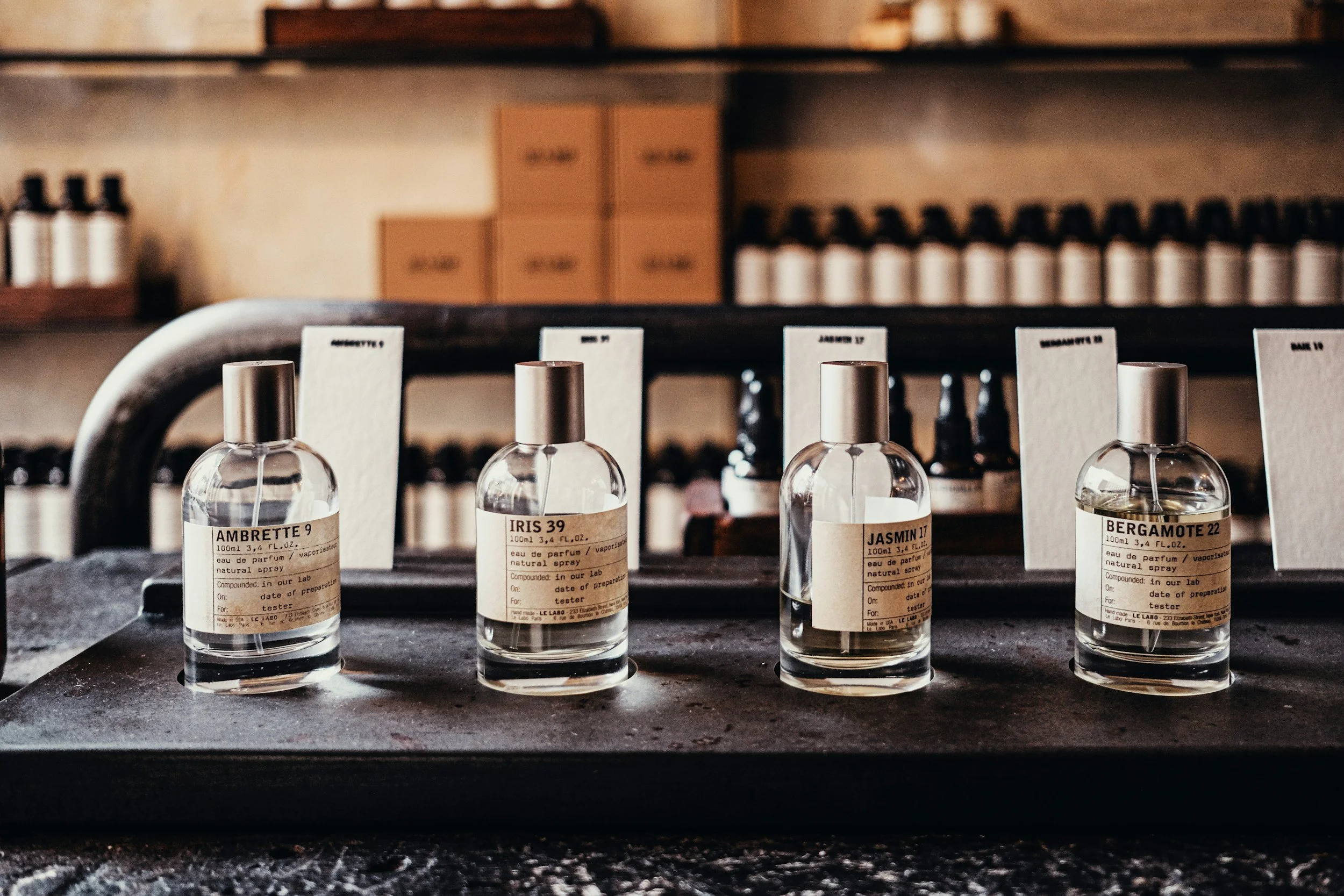
That tiny word “fragrance” on your lotion, candles, and laundry detergent label sounds harmless, but it can hide dozens of hormone‑disrupting chemicals tied to fertility problems, thyroid issues, perimenopause symptoms, and hormone‑sensitive cancers.
In this episode of Wild is Wise, host Sara Estes breaks down the latest research on synthetic fragrances, phthalates, parabens, and even microplastics showing up in women’s reproductive tissues, and explains why this matters whether you’re trying to get pregnant, riding out PMS, or navigating perimenopause.
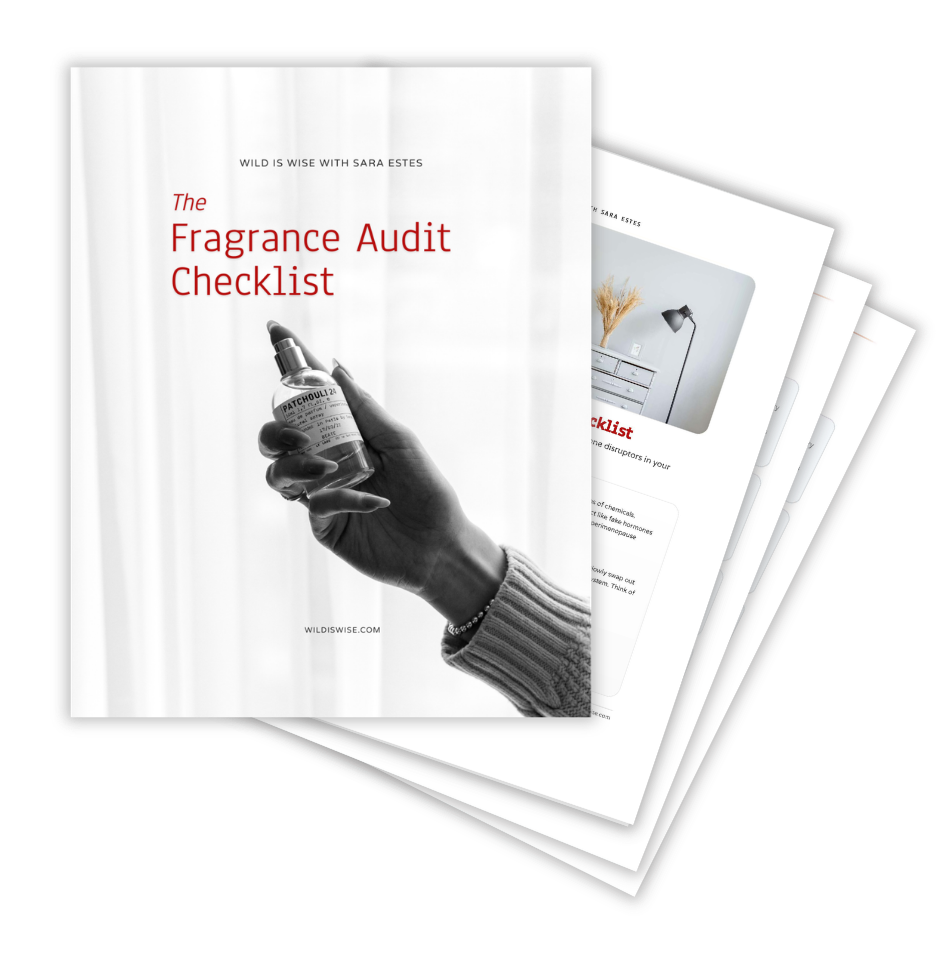
Download the free Fragrance Audit Checklist below ↓
This checklist is designed to help you move through your home, one room at a time, and slowly swap out the highest-exposure products for options that are gentler on your hormones and your nervous system.
You’ll hear how going fragrance‑free became a turning point in Sara’s own health journey after three miscarriages, what recent studies are revealing about plastics and women’s hormones, and how to decode your labels so you know what you’re actually putting on your skin and breathing in every day.
We cover which products to swap first, what “fragrance‑free” really means, how to find safer candles and personal care products, and realistic steps to lower your daily exposure without overhauling your entire life overnight, so you can protect your hormones at any stage of womanhood.
Follow along:
Instagram: @wildiswise
TikTok: @wildiswise
Subscribe + Review
If this episode resonated, please followWild Is Wise and leave a quick review on Apple Podcasts. It helps more women find these conversations and gives the show momentum in the early days. Thanks for listening. See you next week. 🎙️
-
You know that one tiny word on your lotion or candle label—“fragrance”? It sounds harmless, almost cozy. But behind that single word can be dozens of chemicals, including plastic‑based ingredients that act like fake hormones in your body and are now being linked to fertility problems and hormone‑sensitive cancers in new studies. I didn’t learn that in a doctor’s office; I learned it in the middle of three miscarriages and a house full of scented everything. Today we’re pulling back the curtain on synthetic fragrances—what that word really hides, how it’s connected to plastics and hormones, and how to start getting it out of your home without losing your mind.
Welcome to Wild is Wise. I’m Sara Estes, a former private investigator who ditched the high‑stress legal life after a major health crisis. I rebuilt my health from the ground up through nutrition and functional medicine, and now I’m here to uncover the truth about women’s wellness and translate it so you can make informed decisions about your health. On this podcast, we break down women’s nutrition and physiology with real research and practical steps, and we keep coming back to the same idea: what’s found in nature is often exactly what our biology is wired to thrive on.We get nerdy with the science, but we keep it real for everyday life. If you’re ready to understand what your body actually needs, you’re in the right place. As always, this podcast is educational, not medical advice, so please talk to your healthcare provider before making any changes.
Alright—let’s jump in.
Recently I watched the new Netflix documentary The Plastic Detox. It follows couples with fertility struggles who are trying to lower their exposure to plastic‑related chemicals—things like phthalates, BPA, microplastics, and plasticizers that can act like hormones in the body. The filmmakers share newer research where scientists are finding microplastics not just in water and soil, but in human blood and even in reproductive tissues. One 2025 review pulled together several studies showing that microplastics can harm female fertility in animals, and a separate paper reported the first evidence of microplastics in human ovarian fluid—that’s the fluid that bathes your eggs as they mature.
When I saw that, it took me right back to my own fertility journey and to a quiet, overlooked source of plastic‑related chemicals in my life: synthetic fragrance. This episode was really inspired by those two things colliding at once. On one side, you have this documentary showing couples doing everything they can to get plastics and plastic‑related chemicals out of their homes—changing containers, switching products, re‑thinking daily routines. On the other side, you have my lived experience of three miscarriages, three surgeries, and zero conversations about the scented products I was putting on my skin and breathing in all day.
The film talks about phthalates, bisphenols, microplastics, and plasticizers that can act like fake hormones in the body. It’s not just plastic water bottles. It’s food packaging, it’s dust, it’s clothing, it’s the things in our kitchens, and it’s also our cosmetics and our perfumes. Watching that, I realized again how easy it is to focus on the obvious plastics we can see and completely miss the invisible ones we spray on, rub in, and burn in our homes under that tiny, friendly‑sounding word: “fragrance.”
That’s what I want to unpack with you today—how “fragrance” became part of my fertility story, what the latest science is saying about synthetic fragrance and women’s hormones, and how you can start shifting this in your own life in a way that feels doable.
My own story with this started during a really hard season. I went through three miscarriages and three major surgeries. I did endless tests and scans. And the answer I kept getting was some version of, “We don’t really know why this is happening.” At no point did anyone sit me down and say, “Hey, you’re living in a cloud of synthetic fragrance every day, and many of these chemicals are known or suspected hormone disruptors. Maybe we should talk about that.” I had to find that out myself.
As I started digging through the research, I learned something that honestly shocked me. On U.S. labels, the single word “fragrance” or “parfum” is treated as a trade secret. Companies don’t have to tell you what’s inside that mixture. Under that one word, there can be dozens, sometimes hundreds, of separate chemicals: the smell chemicals themselves, solvents to keep everything mixed, preservatives, and “fixers” like phthalates that help the scent last on your skin, your clothes, or in the air.
A 2023 scientific review actually asked this question directly: “Do synthetic fragrances in personal care and household products affect human health?” The authors looked at perfumes, lotions, cleaners, and more, and concluded that fragrance chemicals can trigger headaches, migraines, asthma attacks, skin reactions, and may disturb what they called the endocrine‑immune‑neural axis—which is just a fancy way of saying they can mess with how your hormones, your immune system, and your brain talk to each other. Another paper from 2022 that tested perfumes and colognes found that about three‑quarters of people with breathing problems reported asthma symptoms when they were exposed to perfumes, and in one group of adults, around 20 percent reported respiratory issues and about 5 percent reported actual asthma attacks related to fragrance exposure. That’s about lungs and airways, but it shows you how powerful these mixtures can be at very low doses.
Now let’s connect this to hormones and fertility, because that’s really why we’re here. A 2025 open‑access review called “The impact of perfumes and cosmetic products on human health” pulled together data on common fragrance‑related chemicals—things like phthalates and parabens. The authors pointed out that hormone‑disrupting chemicals such as phthalates, bisphenols, and parabens are frequently found in perfumes and cosmetics, and that they have been linked to interference with hormonal control, fertility problems, thyroid issues, and hormone‑sensitive cancers in several human and animal studies.
Phthalates are one major piece of this puzzle. Phthalates are plasticizer chemicals originally used to make plastics flexible, but they’re also widely used in fragrances to make scents last longer. Diethyl phthalate, or DEP, is one of the most common phthalates in perfumes and personal care products. A 2025 explainer on DEP summarized research showing that in lab and animal models, it can interfere with follicle growth, increase “rust‑like” chemical stress in ovarian tissue, increase egg cell death, and lower egg quality. Human studies have linked higher phthalate levels in blood and urine to altered sex hormone levels and to lower success rates with fertility treatments. That doesn’t prove cause and effect, but it’s enough to make a lot of researchers—and a lot of women—pay attention.
Parabens are another piece. These are preservatives whose names end in “‑paraben,” like methylparaben or propylparaben. In 2025, a Nature Communications paper reported that when pregnant mice were exposed to propylparaben, their daughters and granddaughters had worse fertility, with signs of damaged ovarian function and fewer healthy eggs. Earlier work from the same research group suggested that paraben exposure could drive changes similar to diminished ovarian reserve in humans. And remember, parabens are often used alongside fragrance in lotions and other personal care products.
At the same time, researchers are looking more and more closely at microplastics in female reproductive health. That 2025 review I mentioned found that microplastic exposure in animal and lab models significantly affected ovarian function, lowered fertility rates, and disrupted hormone levels. Another paper, published in 2025 as well, reported the first evidence of microplastics in human ovarian follicular fluid—the fluid that surrounds your eggs as they mature. We don’t fully know what that means yet in real life, but as a woman who’s walked through infertility, just knowing that tiny plastic particles are showing up where eggs live is enough for me to say, “Okay, I’m going to lower my plastic‑related chemical load wherever I reasonably can.”
So if we put this together, we see a pattern. Many synthetic fragrance mixtures contain phthalates and parabens. Phthalates and parabens are now widely recognized as hormone‑disrupting chemicals. They’ve been linked in research to ovarian damage, lower egg quality, disruptions in sex hormones, and hormone‑sensitive cancers, especially when exposure starts early and continues over time. Microplastics and plastic‑related chemicals are being found in some of the most sensitive tissues in the body, including ovarian fluid, and in experimental work they clearly harm female fertility. No one is saying one candle causes infertility. But when you zoom out and look at daily, chronic, low‑dose exposure from dozens of scented products, fragrance becomes a very important lever you can pull if you care about hormones, thyroid, and fertility.
Now I want to bring this back down out of the research papers and into my actual life. During my fertility journey—when I had already lost my gallbladder, when my stress was through the roof, when I was being bounced from scan to scan—no one talked to me about environmental chemicals. At some point, as I started reading more about endocrine disruptors, I took a hard look at my house. I realized my “fresh linen” laundry detergent, my fabric softener, and my dryer sheets all listed “fragrance” on the label. My candles and plug‑ins were pumped full of synthetic scent. My shampoo, conditioner, body wash, lotion, deodorant, and even my makeup primer all had “fragrance” or “parfum” high on the ingredient list.
Once I understood that each of those products could be quietly delivering phthalates, parabens, and other hormone‑active compounds into my body every single day, I decided I couldn’t un‑know that. I made the choice to go completely fragrance‑free. It was one of the hardest practical changes I’ve ever made, because scent is so tied to memory and comfort, and also because I had no idea how many things in my house quietly contained that one word: fragrance.
I didn’t gut my life in one weekend. I went room by room. In the laundry room, I swapped my detergent and fabric softener for truly fragrance‑free versions and ditched the scented dryer sheets. In the bathroom, I slowly cycled out shampoo, conditioner, body wash, and lotion until “fragrance” disappeared from those labels. I learned that “unscented” can still contain masking fragrance, and that “fragrance‑free” is what you actually want if you’re avoiding synthetic scent. I looked for brands that were clear about being phthalate‑free and paraben‑free. In my cleaning supplies, I replaced heavily scented sprays and soaps with simpler, low‑tox, or fragrance‑free options. In my living spaces, I let go of the plug‑ins and strongly scented candles, and if I used candles at all, I chose ones made from simpler waxes, either unscented or very lightly scented with essential oils that I tolerated well.
What surprised me most was how loud synthetic fragrance becomes once you remove it. After a few months of living fragrance‑free, walking through the perfume section of a department store felt like walking into a chemical cloud. I could feel it in my sinuses, my head, sometimes even in my chest. That “normal department‑store smell” suddenly read as a wall of chemicals to my body.
I can’t stand here and tell you that going fragrance‑free was the single magic key that fixed my fertility. Biology is rarely that simple. At the same time that I removed synthetic fragrance, I was also radically improving my nutrition, supporting my gut and liver, stabilizing my blood sugar, and using more bioavailable forms of key nutrients like iron and B12. But I do know that once I spent about three months focusing on nutrient‑dense foods, gut and liver support, lowering obvious endocrine disruptors, and removing synthetic fragrance from my home, my body finally seemed to have enough breathing room to rebalance. My cycles stabilized. My energy improved. A few weeks after that three‑month reset, I conceived and carried my daughter Nova to term. I will never be able to say, “It was this one thing,” but I can say with complete honesty: removing synthetic fragrance is a lever I will never un‑pull.
So if you’re listening and thinking, “Okay, now I’m looking around my house and everything has fragrance on it,” let’s talk about how to start without burning everything down.
The first thing is to become a detective with your labels. Any time you pick up a product—lotion, shampoo, sunscreen, makeup, deodorant, laundry detergent, fabric softener, cleaning spray, candle—turn it over and look for the words “fragrance” or “parfum.” If those words are there and the brand doesn’t clearly say something like “only essential oils” or “phthalate‑free fragrance,” the safest assumption is that it’s a synthetic fragrance mixture that may include phthalates, parabens, and other chemicals you would not choose if you saw them listed one by one. Also scan the ingredient list for names that end in “‑paraben,” like methylparaben or propylparaben. Those are preservatives that a 2025 Nature Communications paper linked to multigenerational fertility problems in mice.
The second thing is to start where your exposure is highest. You don’t have to tackle every single product this week. Focus first on what is on your skin and in your air every single day. That usually means your body wash, your body lotion, your shampoo and conditioner, your deodorant, and the products that scent your whole house, like laundry detergent, fabric softener, dryer sheets, candles, and plug‑in air fresheners. Even mainstream articles now, like a 2025 NPR report on hidden fragrance chemicals in lotions and creams, are telling pregnant women and people trying to conceive to avoid fragranced products when possible, because fragrance is a major source of phthalate exposure.
The third thing is to look for transparency and simple language from the brands you choose. If a product is truly fragrance‑free, it will usually say “fragrance‑free,” not just “unscented.” Many better‑for‑you brands now also say “phthalate‑free” and “paraben‑free” somewhere on the label. Some will list their fragrance components individually or say “only essential oils.” No labeling system is perfect, but any time a brand is willing to be specific rather than hiding behind “fragrance,” that’s a good sign.
As you do this, I want you to keep your nervous system in view, not just your hormones. You don’t have to clear your house overnight. You don’t have to feel shame about the products you’ve used in the past. You are not “toxic” because you liked scented candles. The point here is informed consent. The point is having enough information to say, “Given what we now know about phthalates, parabens, and microplastics, I’m going to lower my exposure to synthetic fragrance where I reasonably can, because my hormones, my future self, and possibly my future children are worth that effort.”
And of course, this is one piece of a bigger picture. On this show we’ve talked about how your gut helps make fuel and support your immune system, how your liver is processing everything from hormones to medications to environmental chemicals, how perimenopause and other hormone shifts can change how your body absorbs and uses nutrients. When you combine fragrance‑free living with nutrient‑dense food, better sleep, stress support, and thoughtfully chosen supplements, you’re not trying to be perfect. You’re stacking small decisions that all point in the same direction.
If this episode resonated with you and you want help taking action, I’m putting together a simple “fragrance audit” checklist you can use room by room. You’ll be able to download it at sarenova.com. It will walk you through exactly what I did: how to read labels, which products to prioritize first, what to look for in safer swaps, and how to do it in a way that feels calm and doable instead of overwhelming.
You don’t have to change everything tomorrow. You don’t have to live in fear. You are allowed to still love scent, and you are allowed to grieve certain products as you let them go. But you are also allowed to choose a future with fewer synthetic fragrances, fewer hormone‑mimicking chemicals in your home, and more respect for what your body is quietly handling every single day.
Your body is wise. Wild is wise. And sometimes the wisest move is as simple as turning a bottle around, finding that tiny word “fragrance,” and deciding it doesn’t get the final say anymore.
Until next time, stay wild, stay wise.